The climate crisis is no longer a distant problem, as it is altering the way companies operate, produce, communicate, and finance themselves.
Have you ever stopped to think about how a heat wave can disrupt production chains? Or how a flood can affect a company's logistics in just a few hours?
According to the Intergovernmental Panel on Climate Change (IPCC), more than 3 billion people live in regions vulnerable to the effects of global warming.
For businesses, this means operational losses, increased insurance costs, regulatory pressure, and changes in consumer preferences.
In this article, I want to explain how the climate crisis affects the productive sector, what risks are involved, and why it is so important to study this topic.

what is at stake?
The climate crisis represents a new type of risk.
Unlike other isolated threats, environmental impacts simultaneously affect productive sectors, financial flows, public policies, and business contracts.
Consequently, companies are required not only to provide timely responses, but also to change their approach to this new reality.
In a brief analysis, we can observe that climate change affects companies on three main fronts:
1 – Physical risks
Extreme events are becoming more frequent and intense, as exemplified by the tragedy that devastated the state of Rio Grande do Sul.
Torrential rains, prolonged droughts, heat waves, wildfires, and cyclones cause direct damage to infrastructure, supply, and operational continuity.
Another critical situation we've observed is the growing instability in Brazilian agricultural production, with losses amounting to billions of reais due to changes in rainfall patterns.
In this sense, we must take into account that industries, commerce, and services are also affected when there is a collapse, whether it be in transportation, energy, or access to raw materials.
The impact ranges from temporary disruptions to the destruction of assets.
2 – The risks of transition
The transition to a low-carbon economy requires regulatory, fiscal, and market changes.
Thus, companies that fail to adapt to new legal requirements (such as carbon neutrality targets, emissions reduction, reverse logistics, etc.) are exposed to sanctions, loss of competitiveness, and exclusion from global value chains.
Furthermore, research has shown that consumers themselves prefer brands committed to the climate agenda.
Thus, environmental regulations and ESG criteria cease to be differentiating factors and become minimum conditions for business survival in an increasingly conscious and regulated market.
3 – Legal risks
You can probably already imagine this, but it's worth remembering that accountability for climate inaction is an increasingly present reality.
In addition to the constitutional duty to protect the environment, companies are being held accountable for transparent practices, diligence in preventing damage, and alignment with public environmental policies.
Climate litigation is already a reality in Brazil, with public civil actions and rulings that mandate compliance with environmental goals.
In this context, a new front for the legal profession emerges: so-called climate litigation , in which investors, consumers, and affected communities seek redress for damages resulting from corporate negligence in the face of climate change.
This means that companies can be held liable in civil, administrative, and in some cases, even criminal proceedings for omissions in mitigating or adapting to climate change effects.
In this regard, the Brazilian Supreme Court has already recognized the omission of the Brazilian State in implementing climate policies, as in the judgments of ADPF 708 and ADO 59.
Naturally, these risks are not limited to the public sector.
Companies of all sizes and sectors should adopt climate governance policies that involve mapping vulnerabilities, defining sustainability goals, creating indicators, and ensuring transparency in corporate reporting.
The case of ADPF 708
The Supreme Federal Court's decision in ADPF 708 (Climate Fund Case) marked a watershed moment in Brazilian environmental jurisprudence.
The Supreme Court recognized the unconstitutional omission of the Executive Branch in implementing the National Climate Change Fund and ordered its immediate operationalization.
The Court affirmed that environmental protection is an unavoidable constitutional duty, especially in light of the escalating climate crisis and the international commitments undertaken by Brazil.
One of the most innovative aspects of the ruling was the equation of environmental treaties with human rights treaties, granting them supralegal status.
According to the votes of Ministers Barroso and Fachin, treaties such as the Paris Agreement and the Convention on Biological Diversity should be interpreted as instruments for the protection of human rights, binding the State and serving as a parameter for the control of the constitutionality and conventionality of domestic norms.
This understanding reinforces accountability for climate omissions in both the public and private spheres.
In other words, companies that ignore their duties regarding environmental mitigation, adaptation, or transparency may face legal sanctions, including in light of so-called climate litigation.
The Supreme Court's decision, in fact, inaugurated a new phase in ecological jurisprudence in Brazil, connected to international trends and aligned with the recognition of the fundamental right to a stable climate and a balanced environment.
Professionals who understand the climate crisis will have a prominent place in the new market.
As you might imagine, companies are being challenged to review their processes, and governments, in turn, are facing increasing pressure for effectiveness and transparency.
The professional world is already feeling the impacts of this transformation.
There is a growing demand for specialists capable of interpreting environmental regulations, assessing climate risks, preparing ESG reports with informational integrity, adapting projects to decarbonization goals, and attracting resources based on sustainable performance.
And of course, this is not a niche exclusive to environmentalists.
Public sector professionals need to understand the legal foundations of climate policy in order to formulate, implement, or oversee environmental actions with confidence.
In the private sector, sustainability managers, corporate lawyers, engineers, economists, administrators, and technology professionals are being called upon to contribute to more resilient, clean, and inclusive production models.
In the third sector, there is also an intensification of the activities of organizations focused on monitoring, knowledge production, advocacy, and social control of climate policies.
It is precisely to respond to this new context that the Professional MBA in ESG, Public Policies and Climate Change , from IDP, was created.
The course offers comprehensive training, geared towards both the public and private sectors, focusing on low-carbon economy, climate justice, organizational strategy, sustainable finance, and practical solutions in sectors such as agriculture, energy, carbon markets, technological innovation, and the use of AI in the ecological transition.
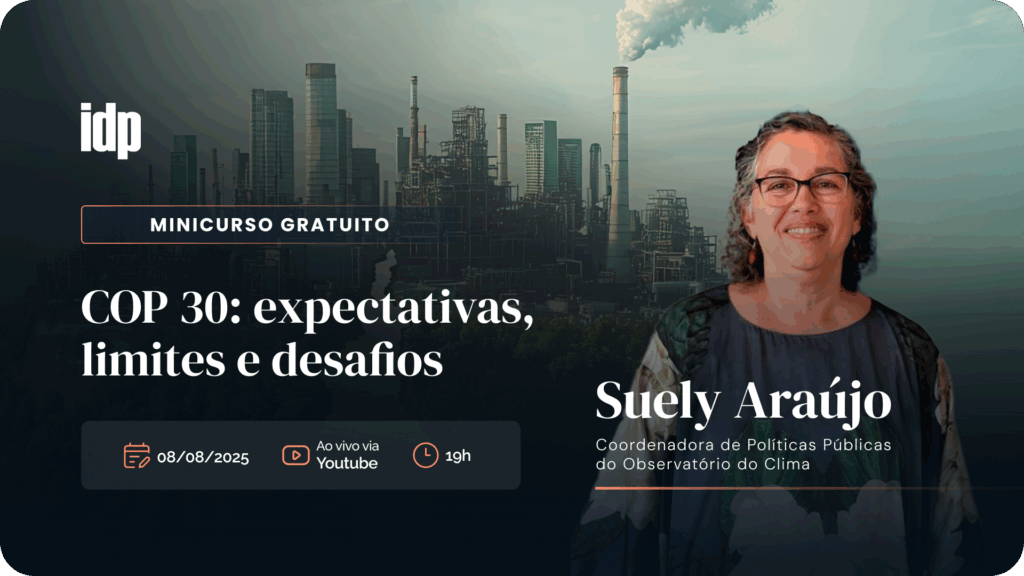
The faculty is composed of specialists with recognized technical, academic, and institutional experience, such as Rodrigo Agostinho (President of IBAMA), Suely Araújo (Former President of IBAMA and coordinator at the Climate Observatory), Carlos Netto, André Lima, Gueitiro Genso, among other names that combine practical experience and the production of qualified knowledge.
The course content covers topics ranging from legal fundamentals and analysis of relevant cases to subjects such as:
- Climate litigation and its outcomes
- Land use change and climate in the Brazilian case.
- Reforestation and economic alternatives to deforestation
- Low-carbon agriculture
- Ecological transition, finance and its challenges.
- Investor and consumer demands
- National and international funding sources for the transition.
- Using technology and AI for transition
- Dimensions of organizational management for transition
Whether you are a public servant, a lawyer, a professional in industry, agribusiness, technology, or finance, the climate transition scenario is already knocking at your door.
And it is clear that the professionals capable of understanding this process, in its legal, institutional, economic, and strategic dimensions, will be the protagonists of the transformation.
Learn more about the course and access the complete training guide:
Online Professional MBA in ESG, Public Policy and Climate Change