

We had the opportunity to discuss some aspects of the Brazilian federal legislative process here on the IDP Blog.
We present the concept of the legislative process and the basic characteristics of the five types of norms foreseen by article 59 of the 1988 Federal Constitution :
- Amendments to the Constitution;
- Complementary Laws;
- Ordinary Laws;
- Delegated Laws;
- Provisional Measures;
- Legislative Decrees; and
- Resolutions.
Next, we will point out the Standing Committees of the Chamber of Deputies and the Federal Senate. Finally, we will briefly comment on how legislative proposals are processed within the National Congress until they reach the President of the Republic for approval or veto.
At this point, we will specifically address Ordinary Bills, which are the most commonly proposed by Legislative Houses. We will discuss the essential requirements for the structure of a Bill, how they are presented, and the usual procedure for these proposals.
We will also discuss how your legal practice can boost the creation of a Bill and make its passage more efficient, whether by mastering the technique of legislative drafting or through advocacy and oratory.
Let's move on!

The Ordinary Bill and its structure: what do I need to know?
There are several different types of legislative proposals, but the Ordinary Bill following the common procedure is the most common. It consists of three phases:
- Pre-parliamentary, Preliminary or Initiative;
- Constitutive or Deliberative; and
- Complementary.
It is in the first phase that the Ordinary Bill is drafted and filed digitally with the Board of the Chamber of Deputies or the Federal Senate, triggering the legislative process.
But in which House are Ordinary Bills usually filed? Professor João Trindade Cavalcante Filho from IDP explains that the initiative generally develops in the Chamber of Deputies. In these cases, the Chamber is called the Initiating House, and the Federal Senate, the Reviewing House.
Another frequently asked question concerns the content of an Ordinary Bill. What is necessary for the proposal to proceed as successfully as possible?
This concern with improving the quality of legislation focuses on the area of Legistics – also known as Legisprudence – which can be formal or substantive. Substantive Legistics seeks to understand the analytical process related to the content of laws. Formal Legistics focuses on legislative technique.
Draft laws, including ordinary laws, should be proposed with attention to quality and prioritizing the effectiveness and efficiency of future regulations.
The act of legislating is certainly motivated by political, legal, and social aspects. However, it cannot be separated from technique, dialogue with institutions, and legislative evaluation processes.
That being said, let's analyze some guidelines provided by the Internal Regulations of the Chamber of Deputies (RICD).
Article 100 and its paragraphs, for example, stipulate that every proposal must be written clearly, in explicit and concise terms. It is also prohibited from containing material extraneous to the objective statement declared in the summary, or derived from it.
Regarding the content of legislative proposals, Article 111 and its paragraphs stipulate that bills must be divided into numbered articles, written concisely and clearly, and always preceded by their respective summary.
Each bill must also contain a statement of legislative intent, and it is prohibited for it to contain two or more different subjects.
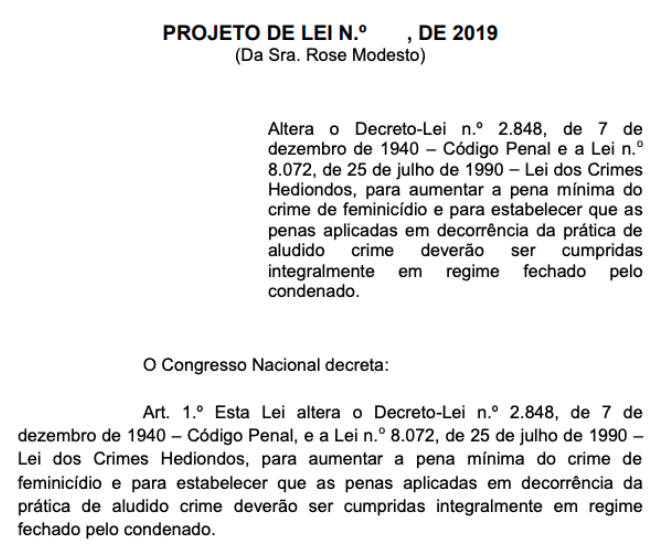
In practice, we observe three parts, outlined by Complementary Law No. 95/1998 . To better understand them, let's take as an example Ordinary Bill No. 1568/2019 , which aims to increase the penalty for the crime of femicide, proposed by Federal Deputy Rose Modesto (PSDB/MS).
The first part, or preliminary part , consists of four elements:
- Title;
- Authorship;
- Menu; and
- Statement of the object.
In the epigraph , the Representative indicated the name that identifies the type of law presented, along with space for the number the Bill will receive in the Chamber, and the year of presentation.
In the authorship field , the name by which she is known as a Member of Parliament is listed.
The syllabus is a clear, accurate, and concise summary of the Project's content.
The statement , in turn, will be in the first article of the text and should indicate what is being proposed.
The second part is called the normative part . It contains the actual rule being proposed, according to the outlines of the Internal Regulations presented above.
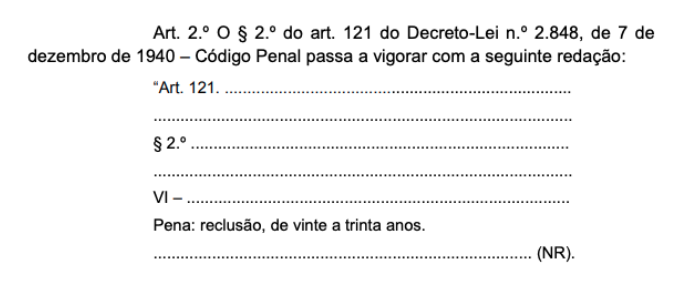
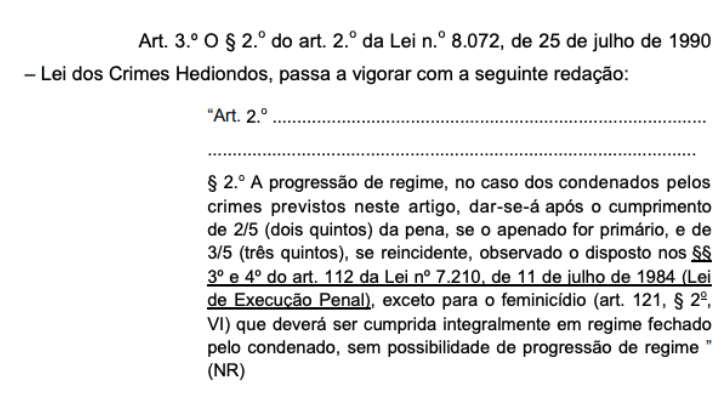
Articles can be subdivided into paragraphs , sections , clauses , and items , if necessary. Ideally, however, each article should address a single issue, considering solutions to the problem raised. In the case we presented, the Representative divided it into only four articles, modifying the existing legislation.
According to the principles of Legislative Drafting, a well-drafted Bill is not necessarily voluminous, with numerous provisions. However, it should be conceived and written from a critical perspective, aiming for the possible resolution of existing conflicts and establishing specific objectives.
The third part, which is the final part, should include some elements.
One is the term of validity, informing when the new law will come into effect and be enforced nationwide. It may contain ostensibly revocation clause, in case it amends an existing law, in whole or in part.

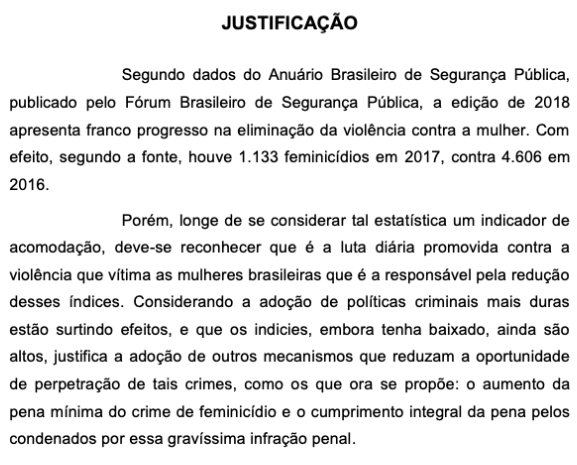
Next, the Ordinary Bill must contain the justification , which is a kind of statement of reasons. It is there that the relevance of the topic is explained, as well as the reasons and arguments that justify the change in legislation.
This is one of the most important parts of the Bill, as it must convince colleagues that there is a socio-legal problem that deserves to be addressed or solved through federal legislation.
It is essential that the Representative exercise persuasive power and present concrete data that validate and illustrate their arguments. The goal is for the matter to be accepted by the others, proceed through the Committees, and reach the Plenary.
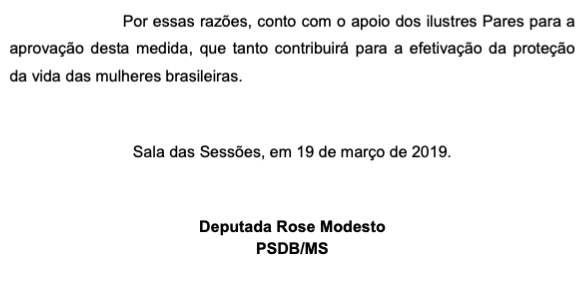
After the Ordinary Bill is presented, it will proceed to specific Committees, depending on the subject matter. Ordinary Bill No. 1568/2019 , for example, was processed by the Constitution, Justice and Citizenship Committee (CCJC) and the Committee for the Defense of Women's Rights (CMULHER), where it received opinions.
In the plenary session, the matter was discussed, received opinions and a substitute bill, before being sent to the Federal Senate , where it will undergo its own processing. If approved by that reviewing chamber, it will go to the Presidency of the Republic, which will either sanction the new law or veto it (in whole or in part).
Is it possible to use my legal practice to influence the drafting of laws?
Although the presentation of a Bill is made by a Member of Parliament, it is possible for Bills to be drafted by third parties. We have heard of Bills produced by committees of legal experts: an example is the drafting of the Preliminary Bill for the Reform of the Law on Administrative Impropriety.
By combining your legal practice with knowledge and expertise in legislative process and drafting legislation, you can draft a bill and hand it over to a member of parliament for signature and presentation in the legislative body.
Another way to leverage your learning is to join a committee of legal experts on a topic you are knowledgeable about, or to offer consulting services to private companies and organizations.
In both of these scenarios, it's important to combine your professional and academic background with strong oratory skills, which are essential for securing employment and developing work that impacts society.
You can also leverage your experience through advocacy in the processing of Bills.
Your role will be to influence Members of Parliament and other decision-makers to expedite the progress of a particular bill that is favorable to the cause you support, or to stall the progress of another proposal that is unfavorable to that cause.
No matter what career path you choose, always keep in mind the importance of specific knowledge for your development.

In this regard, be sure to seek more information about the Postgraduate Program in Legislative Law at IDP and boost your career.
Continue following us on social media, sharing articles from the IDP Blog, and subscribe to our newsletter to stay informed about the main news in the legal world.
References
BRAZIL. Constitution (1988). Constitution of the Federative Republic of Brazil of 1988. Accessed on: October 13, 2022.
BRAZIL. Chamber of Deputies. Resolution No. 17, of 1989. Internal Regulations . Accessed on: October 13, 2022.
BRAZIL. Complementary Law No. 95, of February 26, 1998. Accessed on: October 13, 2022.
CAVALCANTE FILHO, João Trindade. Constitutional Legislative Process . 4th ed. Salvador: Ed. JusPodivm, 2020.
COSTA, Rafael de Oliveira. The role of legal drafting in the (re)legitimization of judicial decisions and in balancing the exercise of the legal-political function by the Courts. Revista da Faculdade de Direito –UFPR , Curitiba, vol. 61, no. 1, Jan./Apr. 2016, pp. 69-86.

