
In a globalized, interconnected, and increasingly transparent world, issues related to international taxation have become one of the biggest day-to-day challenges for businesses.
So today, we're going to talk about international taxation and how to find more effective solutions.
First, let's define the concept of international taxation:

What is international taxation?
In summary, international taxation is the establishment of tax administration standards, which compete with each other for the retention of the taxable base through the establishment of mechanisms that must be replicated by countries.
Furthermore, there are connecting factors in international law that are important for studying conflicts of laws in space, such as:
- residence;
- home;
- nationality;
- source;
- and others.
First of all, let's see what the difference is between Brazil's tax burden compared to other developed countries.
Tax burden in Brazil: a comparative analysis
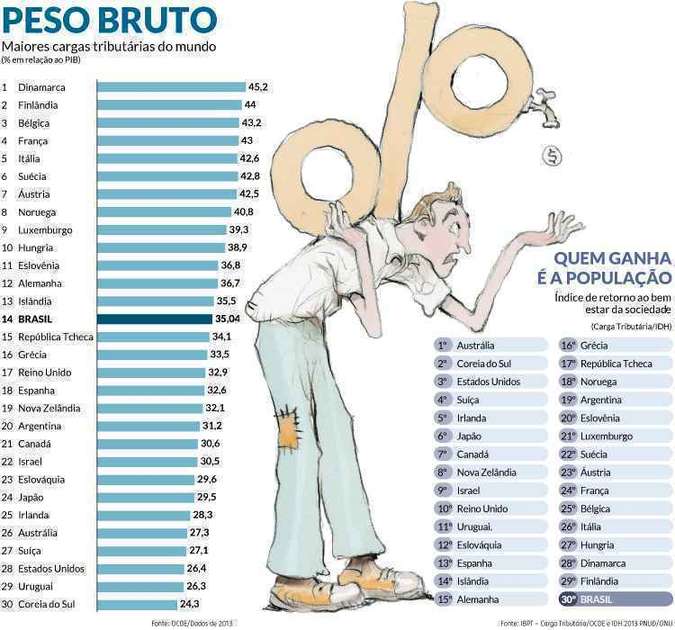
In short, Brazil has one of the highest tax burdens in the world. To give you an idea, the Brazilian tax burden is equivalent to 35,04% of GDP.
However, the United States scores 26,4% on the same index.
Furthermore, according to ICDE/IBGE data, the tax burden in the United Kingdom is more than 2 points lower than in Brazil.
There are also scenarios in advanced countries like Switzerland that show much lower rates, the latter with a tax burden of 27,1%. This corresponds to almost 8% less in taxes than Brazil.
So, regarding international taxation, let's look at the issues in a comparison published by the Economia portal :
Similarly, we have one of the most complex tax systems in the world, which is already difficult for Brazilians to understand. Imagine, then, how it is for foreigners.
Therefore, it's no surprise that one of Brazil's biggest problems is that the tax burden, besides being high, doesn't translate into benefits.
What is the level of taxation in Brazil?
In summary, the level of taxation in the Brazilian system includes the Federal Government, the States, and the municipalities – including the Federal District (an autonomous federative entity).
It occurs at levels to subsidize government actions in providing services to the population, improving infrastructure, and paying administrative staff.
Check out the article about the main points of the National Tax Code here.
Let's now move on to discussing foreign companies and international taxation.
What does it take for foreign companies to invest in Brazil?
First and foremost, Brazil has attracted the attention of many foreign investors due to its natural resources, climate, and vast territory, especially in the areas of mining, energy, and infrastructure.
Furthermore, it is also a strategic country for international taxation due to Mercosur.
Ultimately, establishing a presence in Brazil can be beneficial for those who wish to use the region's free trade agreements to sell products to neighboring countries.
So, regarding international taxation, we will see below two ways in which foreign companies can invest in Brazil: through direct investment and through the physical establishment of foreign companies in the country.
International taxation: how can a foreign company invest directly in Brazil?
Law No. 4.131/62 stipulates the treatment of foreign investment and its respective definition:
Article 1. For the purposes of this law, foreign capital is considered to be goods, machinery and equipment brought into Brazil without initial expenditure of foreign currency, intended for the production of goods or services, as well as financial or monetary resources introduced into the country for application in economic activities, provided that, in both cases, they belong to individuals or legal entities residing, domiciled or headquartered abroad.
Now, let's see how this happens in practice.
Thus, foreign capital invested in the country can enjoy the same legal treatment as national capital under the same conditions, with any discrimination being prohibited (article 2 of Law No. 4.131/62 ).
It is important to highlight one point for the professional who will advise the client: before the first inflow of funds into Brazil, the registration of the entry of foreign capital into the country is mandatory and must be registered with the Central Bank.
In terms of taxation, foreign direct investment capital entering the country is not taxed, except for the IOF tax rate.
Having considered direct investment, let's now look at the second type of investment by foreign companies.

International taxation: how can a foreign company come to Brazil?
To come to Brazil, a foreign company can:
● Open your branch in Brazil;
● Or become a partner in an already established national company.
Basically, these are two different methods to achieve the same result; each method has its own specific characteristics, but the second option may tend to reduce bureaucracy.
In terms of taxation, subsidiaries of international companies must be registered with the commercial registry, the state tax authority, and the municipality. Consequently, their taxation methods are the same as those applied to Brazilian companies.
However, any potential differences are related to the procedure for remitting funds abroad. Even so, the rules will not be significantly different from those of Brazilian companies, since a principle of international taxation is to aim for non-discrimination between countries.

Regarding tax incentives , it's possible to negotiate with the Brazilian government to reach an agreement before the foreign company enters Brazil – this could be at the municipal, state, or federal level . And the impact of this is a significant gain for the organization.
Therefore, in an interconnected world, international tax issues have increasingly become a challenge for businesses.
Here, you've seen some fundamentals of international taxation and the main points a foreign company needs to know in order to invest in Brazil.
Certainly, you will have much more confidence to advise your client on international taxation in practice from now on.